Madeline’s Birth
Lessons in ChemistryMadeline Zott’s birth is a physical ordeal, an anxious reunion, and the beginning of a changed household for Elizabeth Zott and Six-Thirty. After Calvin Evans’s death, the arrival of Elizabeth’s daughter makes a new family possible without erasing the loss. From a labor that begins before Elizabeth recognizes it to Six-Thirty’s clock-based welcome for the infant, the episode introduces a central idea of the novel: kinship takes shape through attention, care, and life lived together, not biology alone.
Causes and Background
Elizabeth has prepared for childbirth in a distinctly practical, incomplete way. She has bought thick white cloth squares, dangerous-looking pins, and three tiny outfits shaped like sacks. She expects the process to be straightforward and believes there are still two weeks to go. Walking with Six-Thirty, she tells him that the important thing will be to stay calm when the time comes. Her confidence rests on a plan that has not accounted for what her body is already doing.
Six-Thirty recognizes the urgency before Elizabeth does. Her water has broken several hours earlier, but she has noticed only a modest amount of moisture; he recognizes its unmistakable scent. What she takes for hunger pains are prelabor contractions. As they near the library entrance, she doubles over and cries out. The contrast between Elizabeth’s calm explanation of childbirth and the dog’s alarm makes the start of labor a scene of unequal knowledge: she is still interpreting events, while Six-Thirty has already understood that something is happening.
Labor and Birth
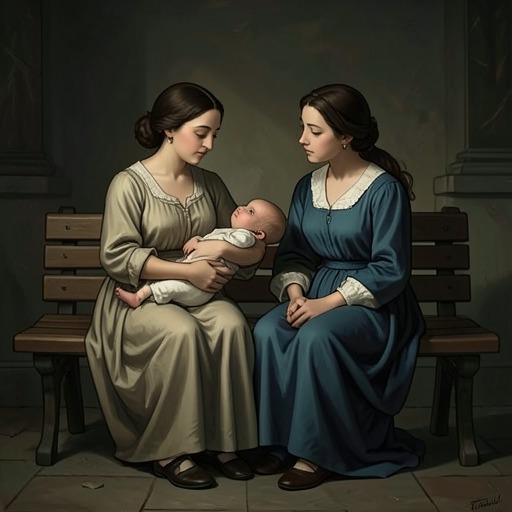
Thirteen hours later, Dr. Mason holds the infant up for Elizabeth to see. He calls the baby a big one and jokes that she will be a rower, probably on the port side. He credits Elizabeth’s time on the rowing erg with helping her through labor and praises her for giving birth without anesthesia. His remarks connect the birth to a physical discipline Elizabeth had already practiced, while his attention to the baby’s lungs and hands projects a future beyond the immediate exhaustion of delivery.
Dr. Mason expects Elizabeth and the baby to remain in the hospital for a few days. Worried about Six-Thirty, however, Elizabeth checks herself out the next morning, against the head nurse’s objection that doing so violates protocol. Thirty minutes after leaving, she reaches the house with the baby tucked against her chest. The journey home is not presented as a triumphant escape from medical care so much as a return to the other dependent being whose welfare has occupied her thoughts throughout the birth.
A Family of Three
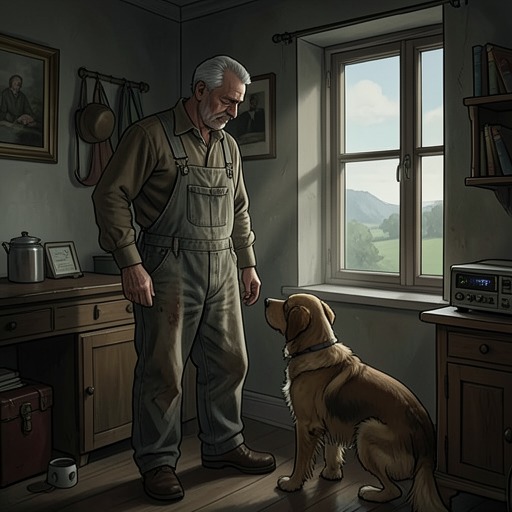
Six-Thirty waits at the front door with his panniers still on, sitting like a sentry. He is relieved to see Elizabeth alive, and she bends to show him the bundle. She tells him it is a girl. The dog greets the newborn as a new member of the household, while Elizabeth apologizes for leaving him alone and notes that he has gone more than twenty-four hours without food. These details place the welcome in the ordinary work of care: the new baby needs attention, but so does the dog who has waited for them.
The family’s clock-based naming custom gives the arrival a place in their shared history. Six-Thirty’s name commemorates the exact time he and Elizabeth became a family; now he understands that the infant will be called Nine Twenty-Two. The names make time more than a way to mark events: it becomes a record of when belonging began. For Six-Thirty, the newborn is not an abstract addition to Elizabeth’s life but someone to greet, feed, and welcome into the home. As the three bustle through the door, a strange joy fills the air. It is the first time since Calvin’s death that Elizabeth feels the household has turned a corner. Ten minutes later, the baby cries, and that fragile calm breaks down. The scene lets renewal and difficulty arrive together rather than treating birth as a simple resolution to grief.
Family Beyond Biology
Later scenes give the birth a wider meaning by showing how the people around Madeline understand family. When Madeline brings Reverend Wakely a clipping of Calvin Evans’s funeral as a family photograph, she identifies Elizabeth, Six-Thirty, herself as having been inside her mother, and Calvin as being in the box. Wakely recognizes that family does not fit neatly on a tree and reaches for the distinction between trees and animals; Madeline is relieved because she has been trying to explain the same idea to Mrs. Mudford. Her account of her own beginning links birth to both loss and belonging: Calvin died before she could meet him, but he remains part of how she understands her family.
Walter Pine’s experience offers another contrast between biological and lived parenthood. After learning through a paternity test that he is not Amanda’s biological father, he finds the result does not change his love for her or his understanding that he is her father. He calls biology overrated. The episode does not equate Walter’s discovery with Madeline’s birth, but the later example reinforces the novel’s refusal to make genetic connection the sole measure of family.
That principle also shapes Elizabeth’s eventual welcome of Avery Parker. Elizabeth tells Avery that Madeline understood long ago that Avery belongs to the family, and explains that Madeline placed Avery—not Wilson—on her family tree. The idea that first appears in the birth scene as a dog’s immediate welcome grows into a broader account of kinship: a child can arrive into a family formed by grief, and family can extend to people connected by memory, recognition, and acceptance as well as by birth.